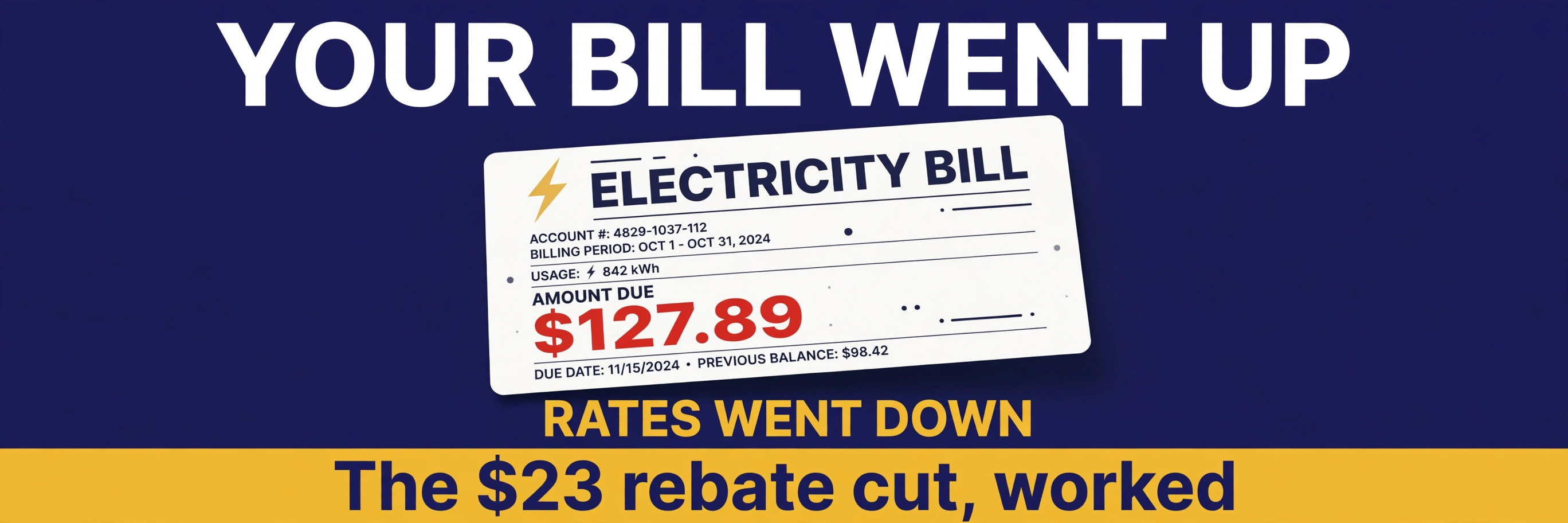
Ontario cut your hydro rate on November 1 — and cut your rebate on the same day. If your first winter bill looks higher than you expected, you are not misreading it. The two changes pull in opposite directions, and for a typical home, the rebate cut pulls harder.
Here is the whole story in one paragraph: the Ontario Energy Board lowered every regulated electricity price by about 7% on November 1, 2026. The provincial Ontario Electricity Rebate fell from 23.5% to 15.7% on the same day. The rate cut saves a typical household a few dollars a month. The rebate cut costs it about $13 a month. Net result: a slightly bigger bill, not a smaller one.
The new prices, in one table
These are the Ontario Energy Board’s Regulated Price Plan prices, in effect November 1, 2026 to October 31, 2027. They cover the electricity itself — delivery and regulatory charges, which vary by utility, sit on top, plus HST.
| Plan | Price |
|---|---|
| Time-of-Use off-peak (weekdays 7 p.m.–7 a.m., weekends/holidays all day) | 9.1¢/kWh (was 9.8¢) |
| Time-of-Use mid-peak (weekdays 11 a.m.–5 p.m.) | 14.6¢/kWh (was 15.7¢) |
| Time-of-Use on-peak (weekdays 7–11 a.m. and 5–7 p.m.) | 18.9¢/kWh (was 20.3¢) |
| Tiered — first 1,000 kWh/month in winter | 11.2¢/kWh (was 12.0¢) |
| Tiered — above 1,000 kWh/month | 13.2¢/kWh (was 14.2¢) |
| Ultra-Low Overnight — 11 p.m.–7 a.m. daily | 3.7¢/kWh (was 3.9¢) |
| Ultra-Low Overnight on-peak (weekdays 4–9 p.m.) | 37.7¢/kWh (was 39.1¢) |
Winter time-of-use hours are also in effect now: the expensive on-peak blocks moved to weekday mornings (7–11 a.m.) and early evenings (5–7 p.m.), and the tiered plan’s cheaper first block grew from 600 kWh to 1,000 kWh a month until April 30, 2027. The OEB’s own newsroom confirms the winter rules, and the rate tables match the OEB’s October 16 announcement.
The worked math: where the $13 goes
The Ontario Electricity Rebate is the provincial credit printed on your bill — a percentage off the subtotal. On November 1 it fell from 23.5% to 15.7%.
The OEB’s own illustration, for a typical household using 700 kWh a month, puts the rebate at about $36 a month under the old rate and about $23 under the new one. That is roughly $13 a month — about $156 a year — gone from the credit side of your bill.
Now the other side. Take a household on tiered pricing using exactly 700 kWh, all inside the first tier. Commodity only — before delivery, regulatory charges and HST:
- Old: 700 × 12.0¢ = $84.00
- New: 700 × 11.2¢ = $78.40
- Saving: $5.60 a month
A $5.60 commodity saving against a roughly $13 rebate loss is the shape of the story. Be careful with the subtraction, though: the rebate is a percentage of the bill subtotal, which includes delivery charges, so the two numbers are not computed on the same base. The honest way to state it is the way the total-bill estimates do. Xolar, working through a Toronto Hydro example, puts a typical 750 kWh home at about $152 a month before the change and about $159 after it — roughly $7 a month more, even though every per-kilowatt-hour price fell. Their breakdown is worth reading if you want the line-by-line version for Toronto; your utility’s delivery charges will move your own number a few dollars either way.
The OEB’s own framing is blunter than the headlines: it says the lower prices are what allow the smaller rebate, and that “the overall rate of increase for customer bills will remain consistent with previous years.” Translation: this was never a price cut designed to shrink your bill. It was a reshuffle.
Which price plan actually wins now?
Most Ontario households are on time-of-use by default, but you can switch — and the November reset is a good moment to check, because the gaps between plans moved. The OEB’s online bill calculator (oeb.ca/choice) compares all three on your own usage; use your actual bill, not a guess. As a rule of thumb:
Stay on time-of-use if most of your electricity already happens off-peak — evenings after 7 p.m., weekends, and holidays — and you can keep the 7–11 a.m. and 5–7 p.m. weekday peaks light. At 9.1¢, off-peak is still the cheapest daytime electricity in the province.
Switch to tiered if your usage is steady through the day, you work from home, or you have electric heat running in the daytime. Tiered charges a flat 11.2¢ for the first 1,000 kWh a month in winter — cheaper than time-of-use mid-peak (14.6¢) and on-peak (18.9¢), dearer than off-peak (9.1¢). If you use a lot of power between 7 a.m. and 7 p.m. on weekdays, tiered usually wins. Energy Efficiency Ontario’s explainer walks through the same comparison.
Ultra-low overnight only if you can genuinely shift big loads past 11 p.m. — an EV charging overnight, laundry and the dishwasher on a timer. The 3.7¢ overnight rate is the cheapest electricity available, but the trap is the other end: 37.7¢ every weekday from 4 to 9 p.m. If your family cooks, heats and lives in the house during those hours, that one block can eat the overnight saving whole. Do not switch to ULO on the overnight number alone.
One more check before you switch: your utility may take a billing cycle or two to apply the change, and switching back is allowed — so treat it as an experiment, and compare two real bills before declaring a winner.
Sunday, November 15: the winter disconnection ban starts
There is a second November 15 date that matters more than the rate table, and it lands on publish day. The Ontario Energy Board confirmed on November 13 that the winter disconnection ban is in effect Sunday, November 15, 2026, through April 30, 2027. During the ban, regulated electricity and natural gas distributors cannot disconnect a residential customer for non-payment, and occupied homes that were cut off before the ban must be reconnected by December 1, free of charge.
Three things the ban does not do, and people get caught on all three:
- It does not erase what you owe. Balances, interest and late-payment charges keep adding up through the winter, and disconnection can resume after April 30.
- It does not cover everyone. Small businesses are not covered, and neither are condos and apartments billed through a unit sub-meter provider — the OEB ban does not apply to those buildings.
- It does not stop notices. A utility can send notices during the ban that take effect on May 1.
If you are behind, the ban is breathing room, not a solution — use the winter to fix the arrears, not to ignore them. Two programs exist for exactly this: the Ontario Electricity Support Program gives eligible lower-income households a monthly credit of $35 to $75 (or $52 to $113 for electric heat and some other homes), and the Low-income Energy Assistance Program offers emergency help when you are behind and facing disconnection. The ban rules and the support programs are summarised together, and the OESP amounts and dates are checked against the OEB.
Three things to do with your next bill
1. Read the rebate line first, not the rate. Your bill’s Ontario Electricity Rebate line should now read 15.7%. If it still says 23.5%, your bill predates November 1 — compare it with the next one before concluding anything. The rate summary is a useful cross-check for the new prices.
2. Run the plan comparison on one real bill. Pull your last bill, note your total kWh and — if you are on time-of-use — roughly how much fell in each period. Ten minutes with the OEB calculator beats a year on the wrong plan, and the saving, if tiered or ULO fits you better, is every month, not once.
3. Budget the extra ~$7 a month, and look one step ahead. A $7 monthly increase is small enough to absorb — and large enough to matter if your budget is already tight, which is the same reason the Bank of Canada’s next decision on December 9 deserves a line in your budget too. If you are renewing a mortgage in 2027, the renewal guide is the place to start; if the extra $7 is coming out of savings, check it is not sitting in an account paying next to nothing — the high-yield savings trap still catches more money than hydro does. And one forward date: from May 1, 2027, the rebate will be capped at the first 1,200 kWh a month, under the Ontario Fall Economic Statement — most households will not notice it, but heavy users should.
The bottom line is not that Ontario hydro got dramatically more expensive. It is that a headline “rates down 7%” hid a rebate cut worth twice as much — and that the household that checks its plan, its rebate line and its arrears position this month is the one that comes out of winter without a surprise. If your paycheque is also shifting in January — CPP down, EI up — our January 2027 paycheque explainer has the worked numbers, and the habits in our emergency-fund guide and how to start investing when your budget finally has room are what turn a $7-a-month change from a leak into a rounding error. The TFSA mistakes to avoid while you are at it are the expensive ones — hydro is not among them, once you have done the math.