
(this post first appeared on our affiliate blog website : AshurSada.com)
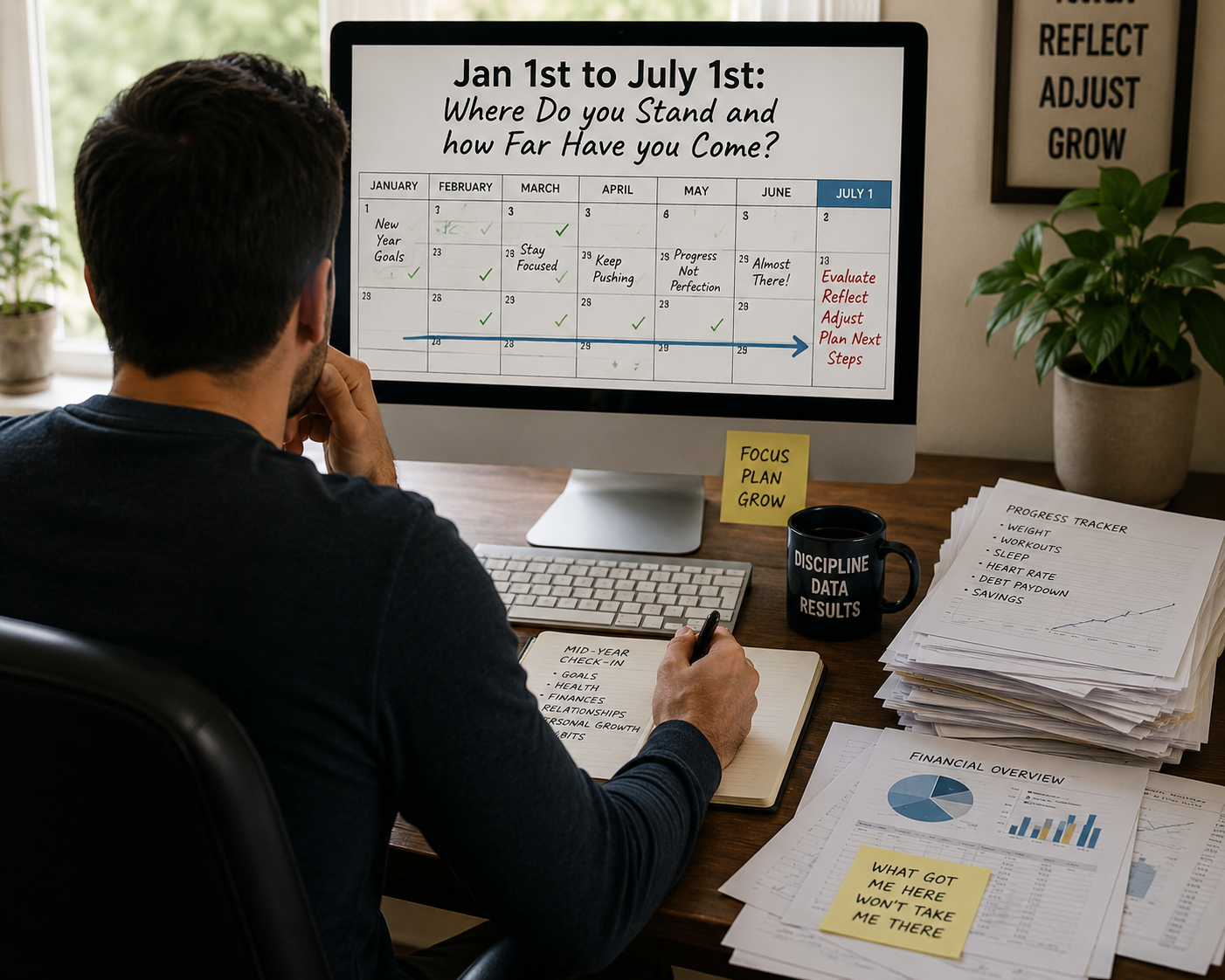
There are two crucial points in the year, where you need to take some time to review your progress, milestones, how you have done and where you are heading: January 1st to start the year and July 1st, as a midway point. Some may choose December 31st instead, as a way to review the year that just ended and that wouldn’t be much different from Jan 1st. Choose the one that feels more right for you, as long as you are doing both check points (first/last and mid point)
So what is the point of these checks and why should you do them? Let us go through them and what you need to pay attention to:
January 1st and July 1st: Your Two Key Checkpoints
This of this as a reset. If you had a bad year, this is your chance to reset things and start fresh. The previous year is gone and done with and you have a new chance to do things differently, better and the way you wanted to last year but things just didn’t go your way. What are some things you need to pay attention to?
Health
Start the year by recording your weight, body fat percentage, heart rate, heart rate, walking heart average rate and any other metric that is of importance to you personally. You can take those using a smart watch like Apple Watch which I personally use. Alternatively, most smart phones have a built in health or activity app which tracks these for you. In fact, 6 months ago, we purchased a new smart scale (StarFit) which connects via bluetooth to an app on your phone and keeps track of 20+ plus health metrics and it has been a game changer for myself and the family, to only track things over time, but be able to tell what is working and what is not in terms of diet and exercise. In addition to these tracking methods, I would recommend you do a full blood work test, which captures all vital health metrics, p[possibly even those that are not routine and may require a payment. All of these various health metrics, whether for your heart, vitamin levels or even activity levels, will come in very handy in the future should you run into a situation where you need to refer to your past numbers and compare to where they are now. The more health datapoints you have, the easier it is to fix and optimize things in the future.
Wealth, Money and Finances
To start the year, take note of your debt, savings, house value, net worth and don’t forget your credit score. If you had previously set any goals for the previous year, assess your progress and where you stand. For example, if you set a goal on Jan 1st 2025 to save $15,000 for a 21 day family cruise around Europe for September 2026, then with about 9 months to go, how far or close are you to meeting your saving goal? This is the power of precise (SMART) goals: they allow you to easily track where you are, without much vagueness. When it comes to debt, it is really important to know what your exact debt balance is, and what it is costing you in interest. Let’s assume you carry a $9,000 balance on a credit card with a 20.99% interest rate and another $5,000 balance on a line of credit with a 7.5% interest rate. Assuming those balances remain unchanged for a full year (and using the stated annual interest rates):
Credit card: $9,000 × 20.99% = $1,889.10 in annual interest
Line of credit: $5,000 × 7.5% = $375.00 in annual interest
Total annual interest: $2,264.10 : That’s about $188.68 per month in interest on average (though actual monthly interest will vary slightly depending on how the lender calculates it and whether the balances change). When you put it into prospective and what your balance is costing you in monthly interest . Based on this, you can decide how much you need to pay every month to bring this balance to at least half by mid year and hopefully fully paid off by the end of the year.
Others
In addition to your health and finances, there may be other aspects of your life worth tracking at the start of the year. These can include things you can objectively measure or simply make note of and review later in the year. What you choose to track will vary from person to person.
Personally, I like to record my car’s odometer reading at the beginning of each year so I can monitor my driving trends. Why is this important? It all comes down to taking good care of your vehicle and making sure you’re not putting unnecessary wear and tear on it. The more you drive, the more you’ll spend on maintenance, and higher mileage can reduce your car’s lifespan and resale value. On top of that, more driving also means spending more money on fuel.
Some people like to measure other aspects of their lives beyond their health and finances. For example, some—including myself—track the number of books they read each year and compare it with previous years. Others monitor their household utility usage, such as electricity, natural gas, or water consumption, to see whether they are using more or less than they did a year ago or even six months ago. Some people enjoy tracking the number of new experiences they have each year, as it can be a reflection of how much they are growing, exploring, and getting out of life. Others prefer to measure the number of hours they volunteer, which can serve as a meaningful indicator of the impact they are making in their communities. Ultimately, there is no right or wrong metric to track. The key is to choose measures that align with your goals and values, because what gets measured is far more likely to improve over time.
The bottom line
Whatever it is that you like to review in your life from a personal development perspective, it is important to establish objective measures and metrics so that it is easy to compare over time and make meaningful adjustments or changes. If you only review what you did over the year or the last six months without taking precise notes on where you stand—weight, debt, heart rate—then how will you know whether you are improving and making progress?
That is the value of data points that you capture at the beginning, throughout, and at the midpoint of the year. As they say, numbers don’t lie, and the more numbers you have, the stronger your foundation becomes for making meaningful, positive changes.